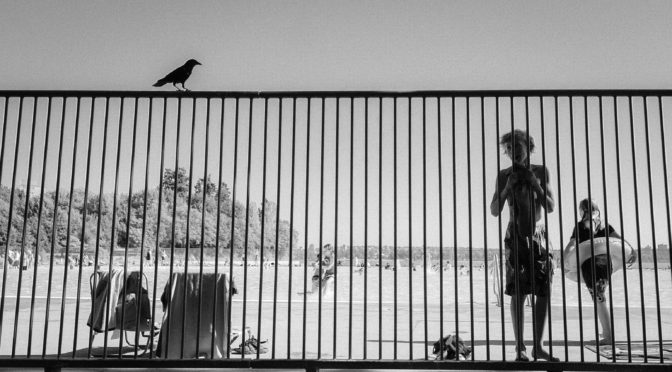
These days I wake up at cat o’clock.  Puss meows to escape, the birds twitter and fuss, a din moments before first light appears on the horizon.  Little cat’s seasonal wildness begins mid-April or so, while mine lies dormant for another month.  By mid-May we are in cahoots while the house sleeps on.

There are a number of ritualistic characteristics to this change.  I sip my latte on the front steps with the morning sun on my face. I abandon housework and drag myself in to make dinner.  I don’t answer the phone.  I wear a baseball cap or wide-brimmed hat and my omnipresent Atlas gloves.  There is a marked reduction in bathing, my earth-stained jeans stand up on their own, I find it harder to write first thing in the  morning, and I stop reading long form.  I want to be deep inside my own head, not somebody else’s.  The children stop shouting for me in the house because I’m not there.

Like the cat, I want to be outside as much and as early as I can.  I want to build and dig, to be outside and free.  If I could run away and live on the land for awhile I would.  I dream of pitching my yurt and drinking in the sounds of everything and nothing, of being unsettled and delighted in the unconstrained openness that is there and not there.   But for now I am in my rural village, enveloped by people and houses.  I work in the yard, under a vow of silence, and imagine my cloak of invisibility.  I am here and not here.

I will be outside again today until I can’t see my hand in front of my face.  Then I will kiss my kids goodnight, consider bathing and slip easily into sleep.

When the sun rises the next day, so will I.


Lovely, lovely short film from production group ThreeShot, filled with sunshine and candy-coloured buildings.  Kiev looks so yummy I mistook it for claymation.

 
Tagged with:
 

The 30-second summary of Shakespeare‘s King Lear is this:

An elderly and increasingly demented King seeks to divide his kingdom in three, according to the degree of publicly pious devotion declared by his three daughters. The two eldest favour him with flattery but the youngest, his favourite, refuses to participate in the tawdry spectacle.  He banishes her immediately and splits his wealth and power between the remaining two.  Without his kingly authority and a house of his own, he is reduced to the status of beggar, destined to split his time between the castles, and authority, of the daughters who disrespect him.  As expected, it all ends badly, amidst suffering, division and loss.  It is a dramatic version of the relationship between parents and their children.

On Saturday night I sat in the audience of the National Arts Centre‘s all-aboriginal production of King Lear and wept as Lear bent over the dead body of his beloved, and unfairly maligned, daughter Cordelia.  I cried for the reunification come too late, for the beauty of their father-daughter bond, for his descent into madness, for the sad complexity of family relations, and for the dreadful, unanswered question “What now?”

These themes run close to my heart.  In January I returned to Vancouver to place my 80-year-old father in a dementia care facility.  His decline was as rapid as Lear’s; in about six weeks he went from the dad I knew to a shadow of his former self.  I hate that he’s in there but there’s no where else he can be.

Alzheimer’s is a disease that runs in his family.  His father died of it, one sister has died of it, and another has been recently placed into a care facility.  There is no doubt about our inherited genetic predisposition, but we are not alone.  One in eight older Americans has Alzheimer’s disease and it is the sixth-leading cause of death in the United States.

Lear had a retinue of one hundred to keep watch over him.  The majority do not share that luxury.  Over 15 million Americans provide unpaid care for a person with Alzheimer’s or other dementias and this care is hard.  Lear clearly wanders and is not easily persuaded to take shelter or rest.  The intense challenges of toileting, eating and other personal caregiving are glossed over.  Curiously, too, the care of the wounded or disabled is handled touchingly by men, often by those who are unrelated to the person.  In reality, women have always been, and continue to be, the primary caregivers for children and the elderly.

So what role does filial piety, loosely defined as honouring one’s father and mother, play in the obligations to support aging parents in need?   Jemima Lewis of The Telegraph thinks that we have lost the habit of caring for our elders.

We British, it is true to say, have fallen out of the habit of filial duty – and not just because we have become a more selfish, welfare-happy nation. There are practical reasons why it is harder now to give shelter to an aged relative. Rising house prices and overcrowding have forced us all into smaller homes. Most of us have barely enough room to store the vacuum cleaner, let alone the chief of our tribe.

Whether from force of historical habit or some innate nurturing instinct, women still tend to feel the tug of family duty more strongly [than men]. The question is, how much more can we cram into our overstuffed lives?

The implementation in Britain of The Poor Relief Act 1601, which was repealed in England and Wales in 1948, undertook to protect the rights of the aged and infirm. Sons were required by law to support their parents and grandparents for the duration of their lives and daughters were obliged for the same until they married. King Lear was written between 1603 and 1606 so that law would have been in effect when the character Lear found himself without home and a means of support. Although they clearly despised him, his daughters could not have refused him hospitality.

Singapore has produced a modern-day version with their  Maintenance of Parents Act:

The Act provides for Singapore residents aged 60 years old and above, who are unable to subsist on their own, to claim maintenance from their children who are capable of supporting him but are not doing so. Parents can sue their children for maintenance, in the form of monthly allowances or a lump-sum payment.  The Act also establishes the Tribunal for the Maintenance of Parents to decide on applications made under the Act.

And every Canadian province, with the exception of Alberta, has its own filial responsibility laws.  In Ontario, it is a single general statement that comprises Section 32 of the Family Relations Act:

Obligation of child to support parent

32.  Every child who is not a minor has an obligation to provide support, in accordance with need, for his or her parent who has cared for or provided support for the child, to the extent that the child is capable of doing so. R.S.O. 1990, c. F.3, s. 32.

Helen Burnett-Nichols foretells the future of these rarely-exercised Canadian laws in her article, My Parents’ Keeper, for Canadian Lawyer Magazine:

With many adult children choosing to take on the responsibility of financially supporting a parent in need, elderly moms and dads heading to court to demand support from kids who are unwilling to pay has proved a rare situation across the country. But as Statistics Canada projects the aging of Canada’s population to rapidly accelerate over the next 25 years, lawyers are divided on the question of whether parental-support cases could become a more prevalent trend.

CBC‘s The Current explored this topic from a Chinese and Canadian perspective.  Click to listen to Part 1 and Part 2 of the podcasts.

In Confucian ideals, filial piety (Chinese: 孝, xiào) is a virtue of respect for one’s parents and ancestors but it encapsulates a much more complex understanding of respect than the Judeo-Christian Commandment to “Honour one’s father and mother.”  Source

Filial piety is considered the first virtue in Chinese culture. In somewhat general terms, filial piety means to be good to one’s parents; to take care of one’s parents; to engage in good conduct not just towards parents but also outside the home so as to bring a good name to one’s parents and ancestors; to perform the duties of one’s job well so as to obtain the material means to support parents as well as carry out sacrifices to the ancestors; not be rebellious; show love, respect and support; display courtesy; ensure male heirs, uphold fraternity among brothers; wisely advise one’s parents, including dissuading them from moral unrighteousness; display sorrow for their sickness and death; and carry out sacrifices after their death. Source

Laws may state our obligations towards parents and grandparents, but there are plenty of personality-and history-based roadblocks that can make living with, and caring for, the aged awfully complex.  King Lear’s eldest daughters were roundly criticized in the play.  But were they garden variety tropes or was there more happening behind the scenes?  Was their attitude towards their father derivative of strained relations between them throughout their life?  Had they been ignored or found less natural favour than their younger sister?  How did their father treat their mother?  How accessible was he to them?  Did they feel loved?  Were they brought up by servants?  Were they despised because they weren’t boys? Did they have conflicting personalities from their father? Were they abused in some way?  Did he work all the time?  These seem like funny, modern questions to ask, but the daughters of Kings would not have been exempt from the desire for parental affection.

Personality and attitude, on both sides, are a critical determinant in whether it is possible to live in a multi-generational household, aged and infirm or otherwise. For example, there is too much baggage to have my mother live with us, although I will always do everything in my power to help her out, mentally and physically.  On the other hand, we are planning to convert our carriage house to a private, accessible suite that suits the needs of my father-in-law and his MS and the concurrent needs of my mother-in-law for some space of her own.  We continue to wrestle with the questions and details of that plan that are yet unanswered.

I wish I could offer up tangible answers to the question left hanging at the end of King Lear, but I can’t.  We’re only going to know if we’ve done right by our parents and grandparents once everything is said and done, once they have passed on.  In the meantime we can only do the best we can do with our resources, attitudes, strengths and weaknesses and love, helping to ease the pain of aging as we are able.


God bless the magic of Twitter.  I love to be surprised by what I find and how I find it.  Everyday is like following Alice down the rabbit hole.

I randomly discovered multidisciplinary artist and musician Lisa Lipton through LOROPR, which called out her upcoming performance art spectacle Window Ballet 2: Electric Boogaloo.  The performance piece riffs on the unexpected snatches of people and action that are only available after dark when we pass by houses that are familiar or strange to us.

The first iteration of Window Ballet (2010) was set inside an illuminated residence as part of Nocturne Halifax.   The play, featuring a multitude of actors and musicians, unfolded in acts which appeared in different windows.  The audience stood outside in the dark looking in, becoming voyeurs and voluntary witnesses to each unfolding scene.

While the venue has changed for 2012, the concept has not.  Unlike the McKittrick Hotel, the exterior walls of the building firmly delineate participant from watcher, the act from the observation.

It’s one of those perfect ideas that occasionally floats by, so catch it if you’re in the neighbourhood.

Performances of Window Ballet 2: Electric Boogaloo:

May 18th and 19th, 2012 @ The Gatekeeper’s Lodge, 5718 Point Pleasant Drive, Point Pleasant Park, Halifax, NS

Two performances each evening @ 9pm and 10pm

But enough talking.  Bring on the peeping.


The stars aligned yesterday for a community idea I’ve wanted to try out for awhile: the spontaneous Front Yard Happy Hour.

We live in a village which sports a tiny public library, a Community Hall, a small public beach, but no economic activity.  The closing of the lovely old General Store, with its beloved seasonal ice cream, means there is less reason to stroll the main street and enjoy chance encounters with the neighbours.  Unless people gather privately (as they do) or partake in the one or two organized community events, it’s possible to go months without seeing one another or socially meet the new faces that show up around town.  I think it’s incredibly important to have fun and not always be picking at the business of community.

I’ve become a fan of the impromptu gathering where fuss, logistics and planning are kept to a minimum so that the hosts can enjoy the event as much as the guests do.  As much fun as it is to be The Hostess With the Mostess, I can definitely do without the pre-and post-event housecleaning/dishwashing and full contact event coordination.

I stocked up on gin, tonic, limes and ice and the simplest munchies, and sent out a brief invite on Facebook and by e-mail:

Inaugural FRONT YARD HAPPY HOUR – TODAY – 5:30 – 7:00pm – Casa Vignuzzi/Cordonier

Consider this the official launch of the 2012 summer social season in Burritt’s Rapids.

We have gin, we have tonic, we have limes and we have ice. Bring your own glass and we will fill it with G&T’s, until 7:00pm (or when the liquor runs out).

Wander by for a chitter chatter. If you want to donate cans of food/drygoods to the Food Bank, cool, bring them along.

Hope to see you here!

I wanted to hold it in the front yard, which is naturally a public-oriented space, where anybody walking by would be invited to spontaneously join in.

Two things particularly pleased me: talk begin immediately about making this a weekly or monthly event that would rotate amongst the properties; and secondly, that such events would be neutral touch points between neighbours who don’t always see eye-to-eye on community politics and policy.  I admit to intervening a couple of times to steer the conversations away from certain button-pushing hot topics.

As expected, Happy Hour extended beyond 7:00pm and a number of people went home particularly happy, including Husband.  The fact everyone could walk home made it even better.

It was a good experiment in possibilities and I look forward to seeing what happens next.  Future events will provide the perfect excuse to try out some of these delectable Happy Hour treats.  Bourbon-Butterscotch-Latte pops, anyone?